
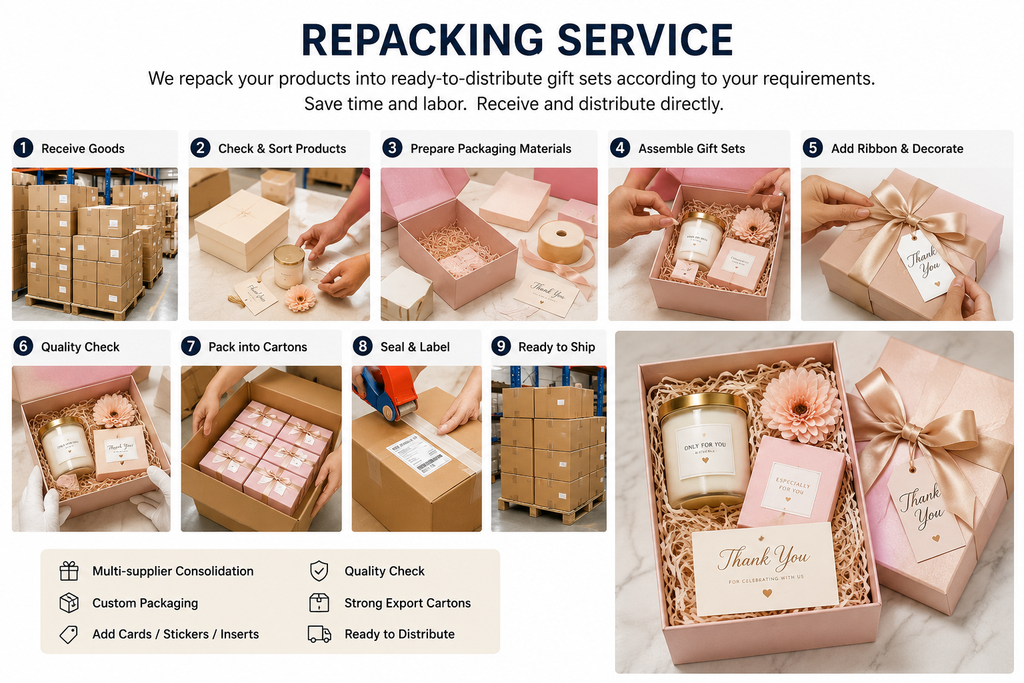
1. Confirm Your Final Packaging Requirements
Repacking starts with understanding how you want the products to look when they arrive at the final destination.
You can provide instructions such as:
- How many items should be packed in each set
- Which products should be grouped together
- What type of gift box or bag should be used
- Whether tissue paper, ribbon or protective material is required
- Whether cards, stickers or inserts should be included
- Whether different colors or styles should be packed separately
- Whether each package needs an individual label
- How many finished sets are required
Clear packing instructions help the warehouse prepare the goods in the exact format you need.
2. Receive Products From One or Multiple Suppliers
The products can be sent to our China warehouse from one supplier or several different suppliers.
For example, a wedding favor set may include:
- Gift box from Supplier A
- Candle from Supplier B
- Small decoration from Supplier C
- Thank-you card from Supplier D
- Ribbon from Supplier E
Instead of asking every supplier to complete part of the final packaging, all components can arrive at one warehouse and be assembled into finished gift sets together.
3. Check All Components Before Repacking
Before the repacking work begins, the warehouse can check whether the required products and packaging materials have arrived.
We can confirm:
- Product quantity
- Packaging quantity
- Box quantity
- Bag quantity
- Cards
- Stickers
- Ribbons
- Inserts
- Accessories
- Different colors or styles
If an important component is missing, the repacking process can be paused until the missing items arrive.
4. Remove Unnecessary Supplier Packaging
Products often arrive in packaging intended only for domestic delivery in China.
When appropriate, unnecessary packaging can be removed before the final packing process.
This may include:
- Domestic courier bags
- Oversized supplier cartons
- Extra plastic wrapping
- Temporary packaging
- Unnecessary inner boxes
- Supplier promotional material
Protective packaging should be retained where it is still needed to prevent product damage.
5. Sort Products by Final Set
The warehouse organizes the products according to your final distribution plan.
For example, if you are preparing 500 wedding favor sets, each finished set may contain:
- 1 gift box
- 1 scented candle
- 1 small decorative item
- 1 thank-you card
- 1 ribbon
The warehouse can separate the components and prepare the required quantity for each finished set.
6. Assemble Wedding Favor Sets
For wedding favors or similar event gifts, the products can be packed into ready-to-distribute sets before international shipping.
A typical packing process may include:
- Opening the gift box
- Placing the main product inside
- Adding additional gift items
- Adding protective filling
- Adding a thank-you card
- Adding an insert
- Closing the box
- Adding ribbon if required
- Applying a sticker or label
- Checking the final appearance
When the goods arrive at your destination, the finished sets can be distributed directly to guests without repacking them again.
7. Create Ready-to-Distribute Gift Packages
The same service can be used for many products beyond wedding favors.
Examples include:
- Wedding gifts
- Birthday party favors
- Baby shower gifts
- Event giveaways
- Corporate gifts
- Promotional gift sets
- Holiday gift boxes
- Customer appreciation gifts
- Product sample kits
- Influencer packages
- Retail gift sets
- Exhibition giveaways
The purpose is to complete repetitive packing work in China before the products are shipped internationally.
8. Combine Products From Different Suppliers Into One Set
One of the main advantages of warehouse repacking is the ability to combine products purchased from different Chinese suppliers.
For example, a corporate gift set could include:
- Notebook
- Pen
- Mug
- USB drive
- Gift card
- Custom box
These items do not need to come from the same supplier.
Each supplier can send their products to our warehouse, and the products can then be combined into one finished gift set according to your instructions.
9. Use Customer-Specified Packaging
If you have already purchased custom packaging in China, it can also be sent to the warehouse.
This may include:
- Gift boxes
- Paper bags
- Fabric pouches
- Drawstring bags
- Retail boxes
- Mailer boxes
- Tissue paper
- Ribbons
- Stickers
- Product cards
- Thank-you cards
- Instruction cards
- Protective inserts
The warehouse can use these materials when assembling the final packages.
10. Add Inserts and Cards
Printed materials can be placed inside each finished package when provided.
Examples include:
- Thank-you cards
- Wedding cards
- Instruction cards
- Promotional cards
- Discount cards
- Product information cards
- Brand inserts
- Event information cards
The customer should confirm where each insert should be placed and which products require it.
11. Apply Stickers and Labels
Labels or stickers can be applied as part of the repacking process.
Depending on your instructions, this may include:
- Product stickers
- SKU labels
- Size labels
- Color labels
- Barcode labels
- Gift labels
- Brand stickers
- Event stickers
- Customer-specific identification labels
Labels should be supplied or clearly specified before packing begins.
12. Pack Different Variations Separately
If the order contains several styles, colors or customer groups, the finished packages can be separated accordingly.
For example:
- Blue gift sets
- Pink gift sets
- Bride-side gifts
- Groom-side gifts
- VIP gifts
- Standard gifts
- Different product combinations
- Different event locations
Each group can be packed and identified separately to make final distribution easier.
13. Standardize the Final Presentation
Repacking can help make products from several suppliers look consistent when they reach the customer.
The warehouse can follow the same packing sequence for each set, such as:
- Same product position
- Same number of items
- Same insert position
- Same ribbon style
- Same protective material
- Same outer packaging
- Same label location
This is useful when the goods will be handed directly to customers, guests or retail buyers.
14. Add Protective Materials
Gift packaging and presentation packaging may not always be strong enough for international transportation.
Additional protection can be added around the finished sets when necessary.
This may include:
- Bubble wrap
- Foam
- Tissue paper
- Protective sleeves
- Dividers
- Air cushions
- Outer cartons
- Corner protection
- Filling material
The goal is to protect the finished presentation during international transportation.
15. Check Finished Sets During Packing
During the repacking process, finished sets can be checked for obvious packing errors.
Typical checks include:
- Correct number of items
- Correct product combination
- Missing accessories
- Missing cards
- Missing stickers
- Incorrect color
- Incorrect packaging
- Damaged packaging
- Poor presentation
This reduces the chance that incomplete sets are shipped internationally.
16. Take Photos of the Finished Packaging
Photos can be taken so you can review the final packing result before the full shipment is dispatched.
The photos may show:
- Open gift box
- Product arrangement
- Inserts
- Cards
- Stickers
- Ribbon
- Closed package
- Multiple completed sets
- Final shipping cartons
If needed, the first completed sample set can be photographed before the remaining quantity is packed.
17. Confirm the Packing Sample Before Full Production
For large repacking orders, it is often useful to complete one or several sample packages first.
The customer can review:
- Product arrangement
- Packaging appearance
- Card placement
- Sticker position
- Ribbon placement
- Protection
- Overall presentation
Once the packing format is confirmed, the warehouse can continue with the remaining quantity.
This helps reduce mistakes when hundreds or thousands of identical sets need to be prepared.
18. Pack Finished Sets Into Shipping Cartons
After the individual packages are completed, they are placed into suitable outer cartons for international transportation.
The warehouse considers:
- Number of gift sets per carton
- Product weight
- Carton strength
- Product fragility
- Empty space
- Protection
- Final carton size
- Shipping method
The objective is to protect the finished packaging while keeping the shipment reasonably efficient.
19. Record Final Quantity
After repacking, the warehouse can confirm:
- Total number of completed sets
- Number of sets per carton
- Number of final cartons
- Remaining unused products
- Remaining packaging materials
- Missing components
- Damaged components
This gives the customer a clear overview before international shipping.
20. Measure and Weigh the Final Shipment
Once all repacking work is completed, the final cartons can be measured and weighed.
We can record:
- Final carton quantity
- Length
- Width
- Height
- Weight per carton
- Total shipment weight
These final figures can then be used for the international shipping arrangement.
21. Ship Ready-to-Use Packages to Your Destination
The main benefit of this service is that the repetitive packaging work is completed before the goods leave China.
When the shipment arrives at your destination, the packages can already be:
- Assembled
- Sorted
- Labeled
- Gift-packed
- Protetto
- Ready for distribution
For wedding favors, event gifts and similar products, this means you do not need to receive hundreds of loose items and spend additional time assembling every package yourself.
The goods can arrive in a format that is ready to hand directly to guests, customers, employees or event organizers.