
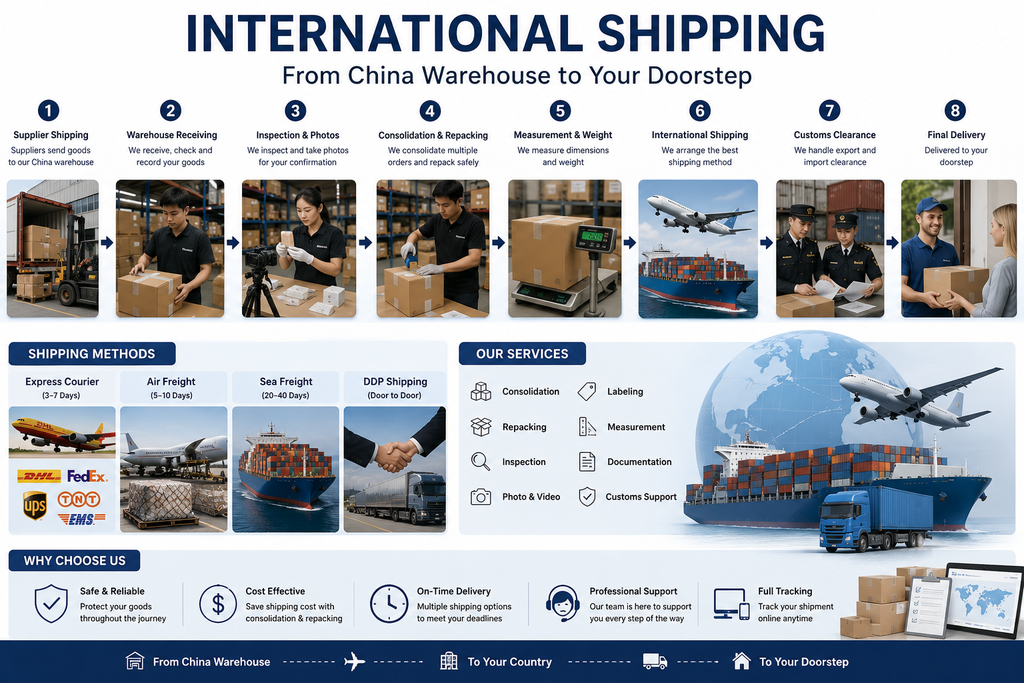
1. Confirm the Shipment Details
Before international shipping is arranged, we first confirm the basic information about the goods.
This normally includes:
- Product name
- סוג המוצר
- כמות
- Number of cartons
- Actual weight
- Carton dimensions
- Destination country
- Destination city
- Delivery address
- Preferred shipping method
- Expected delivery time
- Whether customs clearance support is required
Accurate shipment information is important because different products, destinations and transport methods may have different requirements.
2. Confirm the Product Type
The shipping method depends partly on what is being shipped.
We identify whether the goods are:
- מוצרים כלליים
- Clothing and textiles
- ריהוט
- Building materials
- מכונות
- Electronics
- סוללות
- Energy storage products
- Liquids
- Powders
- חומרים כימיים
- Food products
- Cosmetics
- Branded goods
- Fragile products
- Oversized cargo
Special products may require additional documents, special packaging or specific transport channels.
3. Review Shipping Restrictions
Before arranging transportation, we check whether the product can be accepted by the selected shipping route.
Restrictions may depend on:
- Product category
- Battery content
- Liquid content
- Chemical composition
- Brand
- Destination country
- Airline requirements
- Shipping line requirements
- Courier requirements
- Customs regulations
Some products may require a different route from ordinary goods.
4. Check the Final Packaging
Before international dispatch, the warehouse reviews the final condition of the shipment.
We check:
- Carton strength
- Carton sealing
- Internal protection
- Product movement inside the carton
- Corner protection
- Fragile-product protection
- Pallet condition
- Wooden-case condition
- Strapping
- Stretch film
- Shipping labels
If the supplier’s original packaging is not suitable for international transportation, repacking or reinforcement may be recommended.
5. Measure the Final Cartons
The final packed shipment is measured after consolidation and repacking are completed.
We record:
- Carton length
- Carton width
- Carton height
- Number of cartons
- Pallet dimensions
- Wooden-case dimensions
International freight charges are often calculated using the final packed dimensions rather than the supplier’s original estimates.
6. Record the Final Weight
Each carton or shipping unit can be weighed before quotation or dispatch.
We may record:
- Weight per carton
- Total actual weight
- Pallet weight
- Wooden-case weight
- Consolidated shipment weight
The final shipping weight may differ from the original supplier information because packaging may have been added, removed or replaced.
7. Calculate Volumetric Weight
Some international shipping methods charge according to volumetric weight when the shipment takes up a large amount of space relative to its actual weight.
The chargeable weight may therefore depend on:
- Actual weight
- Carton dimensions
- Carrier calculation rules
- Shipping method
Reducing unnecessary packaging through consolidation and repacking may help reduce shipment volume in some cases.
8. Compare Available Shipping Methods
Depending on the destination, cargo type, weight and required delivery time, different transport options can be considered.
Common options may include:
- International express courier
- Air freight
- Air DDP shipping
- Sea freight
- Sea DDP shipping
- Rail freight where available
- Truck transportation where available
- Special cargo shipping channels
The most suitable option depends on the customer’s priorities.
9. International Express Courier
Courier services can be suitable for relatively small or urgent shipments.
Depending on availability, international courier services may include major global express networks.
Courier shipping is often suitable when:
- The shipment is relatively small
- Delivery speed is important
- The destination has reliable courier coverage
- The goods meet courier acceptance requirements
Courier pricing may be affected significantly by volumetric weight.
10. Air Freight
Air freight can be suitable for larger shipments that need faster transportation than sea freight.
It may be considered for:
- Commercial goods
- Medium-sized shipments
- Time-sensitive products
- Higher-value goods
- Regular business shipments
Air freight arrangements may involve airport-to-airport, airport-to-door or door-to-door services depending on the route.
11. Sea Freight
Sea freight is commonly used for larger, heavier or less time-sensitive shipments.
It may be suitable for:
- ריהוט
- Building materials
- מכונות
- Large commercial orders
- Palletized cargo
- Wooden cases
- Heavy products
- High-volume shipments
Sea freight usually has a longer transit time than air shipping but can be more economical for larger cargo.
12. DDP Shipping
DDP shipping may be available on selected routes.
Depending on the route and service arrangement, a DDP solution may include:
- Export transportation from China
- International transportation
- Customs clearance arrangements
- Import-duty or tax handling according to the agreed quotation
- Last-mile delivery
The exact scope should always be confirmed in the shipping quotation because DDP service conditions can vary by destination and product type.
13. Non-DDP Shipping
For some shipping methods, import customs clearance, duties or taxes may remain the responsibility of the receiver.
Before shipment, it is important to confirm:
- Who will act as the importer
- Who will handle customs clearance
- Who will pay duties
- Who will pay import taxes
- Whether a customs broker is required
- Whether the receiver needs an import license
These responsibilities should be understood before the goods leave China.
14. Prepare Commercial Shipping Information
International shipments normally require basic commercial information.
Depending on the shipment, this may include:
- Shipper information
- Receiver information
- Product description
- כמות
- Declared value
- Country of origin
- HS code information where available
- Commercial invoice
- Packing list
The information must reasonably match the actual goods being shipped.
15. Prepare Product-Specific Documents
Some products may require additional documentation before transportation.
Examples may include:
- Battery documents
- UN38.3 test summary
- SDS or MSDS
- Product specifications
- Certificates
- Ingredient information
- Material information
- Import permits
- Compliance documents
Required documents depend on the product, shipping method and destination.
16. Confirm Receiver Information
Before dispatch, the receiver information should be checked carefully.
This normally includes:
- Receiver name
- Company name
- Street address
- City
- State or province
- Postal code
- Country
- Telephone number
- Email address
- Tax number where required
- Importer information where required
Incorrect receiver details can cause customs or delivery delays.
17. Confirm the Shipping Quotation
The final quotation is normally based on the actual packed shipment information.
The quotation may consider:
- Cargo type
- Actual weight
- Volumetric weight
- Number of cartons
- יעד
- Shipping method
- Customs requirements
- טיפול מיוחד
- Delivery conditions
Customers should confirm what is included in the quotation before payment and dispatch.
18. Confirm What the Shipping Price Includes
Depending on the selected service, the shipping price may include different items.
These may include:
- China domestic handling
- Warehouse handling
- Export transport
- Air freight
- Sea freight
- Customs clearance
- Duty handling
- Last-mile delivery
- Fuel surcharge
- Remote-area surcharge
- Oversized-cargo surcharge
The exact included services should be confirmed for each shipment.
19. Final Pre-Shipment Check
Before the goods leave the warehouse, a final check can be completed.
This may include:
- Final carton count
- Final weight
- Final dimensions
- Packaging condition
- Shipping labels
- Receiver information
- Shipping documents
- Special handling instructions
Photos of the completed shipment can also be taken before dispatch.
20. Apply Shipping Labels
Each carton or shipping unit is labeled according to the selected transport method.
Labels may include:
- Shipment reference
- Carton number
- Receiver information
- Tracking information
- Handling labels
- Carrier labels
- Special cargo markings where required
Labels must remain visible and securely attached during transportation.
21. Handover to the Carrier
After the shipment is prepared and the required arrangements are confirmed, the goods are handed over to the selected logistics provider.
The handover may be to:
- Courier company
- Air freight agent
- Airline handling facility
- Sea freight forwarder
- Container loading facility
- Trucking provider
- Special cargo carrier
The warehouse records the shipment handover status.
22. Export Transportation From China
Depending on the route, the shipment may first move from the warehouse to:
- Courier sorting center
- Airport cargo terminal
- Freight consolidation warehouse
- Seaport
- Container warehouse
- Export handling facility
Export procedures are then completed according to the selected transport method.
23. International Transit
After departure from China, the shipment moves through the international transportation network.
Depending on the route, this may involve:
- Direct flight
- Connecting flight
- Ocean vessel
- Transshipment port
- Regional distribution hub
- Rail connection
- Truck connection
Transit routes may change depending on carrier schedules and operational conditions.
24. Tracking Information
Where tracking is available, the customer can receive shipment information after dispatch.
Tracking may include:
- Carrier tracking number
- Air waybill number
- Courier tracking number
- Container information
- Local delivery tracking number
Some DDP or multi-stage shipments may use more than one tracking number during the transportation process.
25. Tracking Number Changes
For some shipping routes, the tracking number used during the international stage may be different from the number used for final local delivery.
For example:
- One number may track transportation from China
- Another number may be assigned after customs clearance
- A local courier may issue a new tracking number for final delivery
This is normal for some door-to-door logistics services.
26. Arrival at the Destination Country
When the shipment reaches the destination country, it may enter:
- Airport cargo terminal
- Seaport
- Customs warehouse
- Courier hub
- Bonded warehouse
- Logistics distribution center
The next step depends on the shipping method and customs arrangement.
27. Customs Clearance
The shipment may require customs clearance before domestic delivery can begin.
Customs may review:
- Product description
- Declared value
- Commercial invoice
- Packing list
- HS code
- Importer information
- Product documents
- Taxes and duties
- Import restrictions
Customs authorities may request additional information for some shipments.
28. Customs Duties and Taxes
Whether import duties and taxes are included depends on the shipping service selected.
For DDP services, certain import costs may be included according to the confirmed quotation.
For non-DDP shipments, the receiver may be responsible for:
- Import duty
- VAT or GST
- Customs brokerage
- Local taxes
- Customs-related fees
The final treatment depends on the destination country and shipment arrangement.
29. Customs Inspection
Some shipments may be selected for customs inspection.
This can involve:
- Document review
- Package inspection
- Product inspection
- Value verification
- Classification verification
- Additional document requests
Customs inspection is controlled by the relevant authorities and can affect delivery time.
30. Release From Customs
Once customs procedures are completed, the shipment is released for the next stage.
Depending on the service, the cargo may then move to:
- Local courier
- Regional warehouse
- Trucking company
- Distribution center
- Final-mile delivery network
31. Last-Mile Delivery
For door-to-door shipping, the final transportation stage delivers the shipment to the receiver.
Depending on the destination and shipment size, delivery may be completed by:
- Local courier
- Parcel delivery company
- Trucking company
- Freight delivery company
- Pallet delivery service
Large shipments may require the receiver to arrange suitable unloading conditions.
32. Delivery Appointment for Large Cargo
Furniture, machinery, pallets and other large shipments may require a delivery appointment.
The receiver may need to prepare:
- Forklift
- Loading dock
- Warehouse staff
- Suitable unloading area
- Delivery access
- Appointment time
Delivery conditions should be confirmed in advance for oversized or heavy cargo.
33. Final Delivery Confirmation
Once the shipment reaches the destination, the customer should check the external condition of the goods before or during receipt where practical.
If obvious damage is visible, it is useful to:
- Photograph the cartons
- Photograph damaged areas
- Keep the packaging
- Record the delivery condition
- Retain the delivery documents
- Contact us promptly
These records may be important if a transportation claim needs to be reviewed.
34. Transit Time
Shipping times depend on the selected route and service.
Transit time may be affected by:
- Destination country
- Shipping method
- Carrier schedule
- Flight availability
- Vessel schedule
- Customs clearance
- Peak season
- Weather
- Public holidays
- Remote-area delivery
- Customs inspection
Unless specifically agreed otherwise, transit times should generally be treated as estimates rather than guaranteed delivery dates.
35. Shipping Cost Optimization
When possible, we can review the shipment before dispatch to identify opportunities to reduce unnecessary shipping costs.
This may include:
- Consolidating multiple supplier shipments
- Removing unnecessary packaging
- Repacking oversized cartons
- Separating incompatible goods
- Comparing shipping methods
- Comparing actual and volumetric weight
- Selecting suitable transport routes
The lowest-cost option is not always the best option if it increases the risk of damage or significantly increases delivery time.
36. Multi-Supplier International Shipping
If you purchase from several Chinese suppliers, their goods do not need to be shipped internationally one by one.
Products can first arrive at our China warehouse for:
- Receiving
- Order matching
- Inspection
- Photo confirmation
- איחוד משלוחים
- אריזה מחדש
The completed shipment can then be sent internationally as fewer shipping units.
This can simplify the shipping process and may reduce unnecessary duplicate transportation costs.
37. Shipping Fragile Goods
Fragile goods may require additional packaging before international transportation.
Examples include:
- Glass
- Ceramics
- Lighting
- ריהוט
- Stone products
- Electronic equipment
- Decorative products
Additional protection may include:
- Foam
- Bubble wrap
- Corner protectors
- Strong cartons
- Wooden cases
- Pallets
- Internal dividers
38. Shipping Heavy or Oversized Goods
Heavy or oversized cargo requires different planning from ordinary parcel shipments.
The shipping arrangement may consider:
- Product dimensions
- Total weight
- Forklift requirements
- Pallets
- Wooden cases
- Loading conditions
- Destination unloading conditions
- Truck delivery
- Sea freight
Final packaging and handling should be confirmed before dispatch.
39. Shipping Batteries and Special Cargo
Batteries, chemicals, liquids and other special products may be subject to additional transport requirements.
Before shipping, we may need to confirm:
- Product classification
- Battery type
- Battery specifications
- Safety documents
- Packaging requirements
- Carrier acceptance
- Destination restrictions
These goods should not be treated as ordinary general cargo without reviewing the relevant shipping requirements.
40. Photo Confirmation Before Dispatch
Customers can request final shipment photos before the goods leave our China warehouse.
The photos may show:
- Final cartons
- Carton quantity
- Packaging condition
- Pallets
- Wooden cases
- Shipping labels
- Reinforcement
- Consolidated shipment
This provides a final visual record before international transportation begins.
41. From China Warehouse to Final Delivery
The complete international shipping process can therefore include:
- Supplier delivery to our China warehouse
- Warehouse receiving
- Product checking
- Photo and video confirmation
- איחוד משלוחים
- אריזה מחדש
- Final measurement
- Final weighing
- Shipping quotation
- International transportation
- Customs clearance
- Last-mile delivery
The goal is to give overseas buyers one coordinated process from receiving goods in China to arranging delivery at the destination.