
Clothing & Textiles Inspection
1. Shipment Identification and Receiving Check
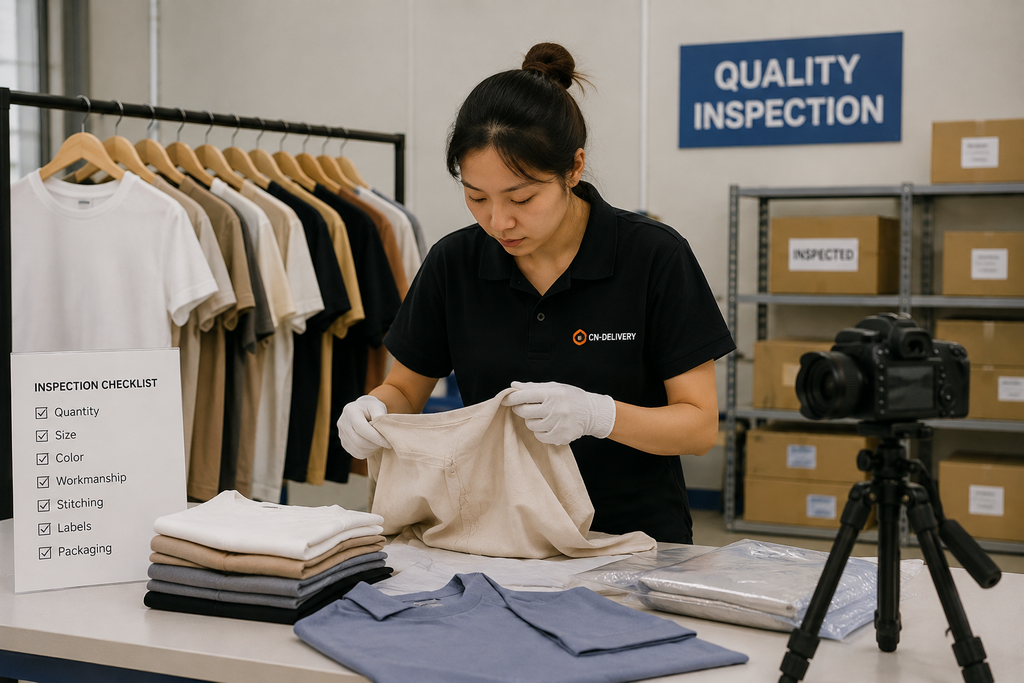
When the shipment arrives at our China warehouse, we first match it with the customer order using the supplier name, domestic tracking number, customer reference, carton quantity and product information.
We confirm:
- Supplier name
- Numéro de suivi national
- Number of cartons received
- Product name and SKU
- Ordered quantity
- Color breakdown
- Size breakdown
- Packing list information
If products arrive from several suppliers, each incoming shipment is recorded separately before inspection.
2. Outer Carton Inspection
Before opening the cartons, we check the external packaging for visible transport damage.
We look for:
- Crushed cartons
- Torn or punctured cartons
- Water marks
- Moisture
- Opened cartons
- Loose tape
- Damaged corners
- Incorrect carton markings
- Missing cartons
Any visible carton damage is photographed before opening the package.
3. Quantity Verification
The received quantity is compared with the customer’s order list or packing list.
The inspection can include:
- Total quantity
- Quantity per carton
- Number of SKUs
- Quantity by color
- Quantity by size
- Quantity by model
- Missing products
- Extra products
- Mixed products
For large orders, the inspection scope can be based on the customer’s agreed checking requirements.
4. Style, Color and Size Verification
Products are compared with the order information, supplier product link, reference photos or customer instructions.
We can check:
- Product style
- Couleur
- Taille
- Modèle
- Fabric appearance
- Printed pattern
- Embroidery
- Logo position
- Design details
- Product variation
We also look for obvious inconsistencies between different pieces or production batches.
5. Visible Workmanship Inspection
Selected products can be checked for visible workmanship problems.
Typical checks include:
- Loose threads
- Open seams
- Uneven stitching
- Missing stitches
- Broken zippers
- Missing buttons
- Loose buttons
- Incorrect pocket position
- Uneven hems
- Damaged elastic
- Misaligned printing
- Poor embroidery
- Visible glue marks
- Incorrect labels
6. Stain and Damage Inspection
The product surface is checked for visible defects such as:
- Oil stains
- Dirt
- Ink marks
- Discoloration
- Mold marks
- Holes
- Cuts
- Fabric damage
- Scratches
- Burn marks
- Other visible contamination
Clear close-up photos can be taken when defects are found.
7. Label Inspection
Product labels can be checked against the customer’s requirements.
Cela peut notamment inclure :
- Size labels
- Care labels
- Brand labels
- Country-of-origin labels
- Hang tags
- Barcode labels
- SKU labels
- Product information labels
8. Individual Packaging Inspection
We check whether the individual product packaging is consistent with the agreed requirements.
Cela peut notamment inclure :
- Poly bags
- Retail boxes
- Protective wrapping
- Barcode placement
- Hang tags
- Size stickers
- Product folding
- Packaging condition
9. Photo and Video Documentation
Inspection records can include:
- Outer carton photos
- Open-carton photos
- Product overview photos
- Color photos
- Size label photos
- Detail photos
- Packaging photos
- Defect close-ups
- Short inspection videos
10. Problem Handling
If obvious problems are found, the affected products can be separated and documented before international shipping.
Common issues include:
- Wrong product
- Wrong size
- Wrong color
- Missing quantity
- Visible defects
- Damaged packaging
- Incorrect labels
The customer can then decide whether the supplier should replace, return, rework or resend the affected goods before the international shipment is prepared.
Furniture & Building Materials Inspection

1. Shipment Identification and Document Check
When furniture or building materials arrive at the warehouse, we compare the received shipment with the information provided by the customer.
We review:
- Supplier name
- Modèle du produit
- Quantité
- Product dimensions
- Couleur
- Finish
- Material description
- Packing list
- Photos des produits
- Drawings or specification sheets when available
- Accessory list
2. Outer Packaging Inspection
Large furniture and building materials are especially vulnerable to transportation damage, so the external packaging is checked before unpacking.
We inspect:
- Cartons
- Wooden crates
- Palettes
- Strapping
- Stretch film
- Protective foam
- Corner protectors
- Waterproof wrapping
We look for:
- Crushed packaging
- Broken wooden crates
- Broken pallets
- Torn wrapping
- Water damage
- Exposed products
- Loose straps
- Damaged corners
3. Quantity and Component Verification
The number of products and major components is compared with the packing list.
Depending on the product, this may include:
- Main furniture pieces
- Panels
- Legs
- Handles
- Hinges
- Screws
- Bolts
- Brackets
- Glass panels
- Hardware
- Installation accessories
- Spare parts
- Mounting components
This is especially important for products that require assembly after delivery.
4. Model and Specification Check
The received goods can be compared with customer-provided specifications.
We can check:
- Model number
- Type de produit
- Couleur
- Surface finish
- Texture
- Material appearance
- Design
- Pattern
- Hardware type
- Configuration
5. Dimension Verification
Key product dimensions can be measured when required.
Typical measurements include:
- Longueur
- Largeur
- Hauteur
- Thickness
- Panel dimensions
- Hole spacing
- Glass dimensions
- Tabletop dimensions
- Door dimensions
- Package dimensions
The customer should specify which dimensions are critical before inspection.
6. Surface Condition Inspection
Visible surfaces are inspected for obvious defects.
Typical checks include:
- Scratches
- Cracks
- Chips
- Dents
- Broken corners
- Paint damage
- Rust
- Uneven coating
- Surface contamination
- Glass damage
- Stone damage
- Tile breakage
- Laminate damage
7. Basic Structural Check
Where practical, visible structural areas can be checked.
Cela peut notamment inclure :
- Loose joints
- Bent components
- Broken frames
- Misaligned panels
- Damaged hinges
- Damaged drawer slides
- Loose handles
- Incorrect mounting holes
8. Basic Assembly or Fit Check
For suitable products and when requested, a basic fit or assembly check may be performed.
En voici quelques exemples :
- Checking whether legs fit the tabletop
- Checking whether screw holes align
- Checking whether handles fit correctly
- Checking whether cabinet doors open and close
- Checking whether drawers slide
- Checking whether hinges move normally
- Checking whether major components match each other
Complex full installation should be confirmed separately before inspection.
9. Packaging Protection Assessment
Before international shipping, we check whether the existing packaging provides reasonable protection for the product.
We review:
- Foam protection
- Corner protection
- Bubble wrap
- Carton strength
- Wooden crate protection
- Pallet condition
- Strapping
- Internal movement inside the package
For fragile or heavy products, additional reinforcement may be recommended.
10. Photo and Video Documentation
Inspection documentation can include:
- Outer packaging photos
- Product overview photos
- Surface detail photos
- Dimension measurement photos
- Accessory photos
- Damage photos
- Assembly or fit-check photos
- Repacking photos
- Short inspection videos
11. Problem Handling
If problems are found, the affected goods can be documented and separated before international shipping.
Typical problems include:
- Missing parts
- Wrong model
- Wrong dimensions
- Wrong color
- Surface damage
- Broken glass
- Cracked panels
- Damaged accessories
- Inadequate packaging
The customer can then decide whether the supplier should replace, repair, return or resend the affected goods.
Energy Storage Battery Inspection

1. Shipment Identification
Battery shipments are first identified and matched with the customer order.
We confirm:
- Fournisseur
- Nom du produit
- Type de batterie
- Composition chimique des batteries
- Modèle
- Quantité
- Nombre de cartons
- Number of pallets
- Rated voltage
- Rated capacity
- Product configuration
Typical products may include:
- LiFePO4 battery packs
- Lithium-ion battery packs
- Energy storage battery modules
- Rack-mounted batteries
- Home energy storage batteries
- Centrales électriques portables
2. Outer Packaging Inspection
Before opening the shipment, the warehouse checks the external packaging for visible damage that could affect battery safety.
We look for:
- Crushed cartons
- Punctured cartons
- Broken wooden crates
- Damaged pallets
- Loose straps
- Water damage
- Exposed battery products
- Severe impact marks
- Damaged protective materials
3. Battery Appearance Inspection
The battery housing is inspected for obvious visible abnormalities.
We look for:
- Swelling
- Deformation
- Cracked housing
- Leakage
- Burn marks
- Severe scratches
- Impact damage
- Corrosion
- Broken covers
- Loose components
- Signs of overheating
Any battery showing obvious swelling, leakage or serious physical damage should not be handled as ordinary cargo.
4. Model and Specification Verification
The information printed on the battery is compared with the customer order or specification.
We can check:
- Model number
- Rated voltage
- Rated capacity
- Energy rating
- Composition chimique des batteries
- Informations sur le fabricant
- Product serial information where available
5. Quantity Verification
The received quantity is compared with the packing list.
Cela peut notamment inclure :
- Battery units
- Modules de batterie
- Blocs-batteries
- Chargers
- Cables
- Connectors
- Communication cables
- Mounting brackets
- Screws
- Accessoires
- User manuals
6. Terminal and Connector Inspection
Accessible terminals and connectors are visually inspected.
We look for:
- Damaged terminals
- Bent terminals
- Exposed conductive parts
- Missing terminal protection
- Broken connectors
- Damaged cables
- Loose connectors
- Visible corrosion
Terminal protection is particularly important before transport.
7. Label and Marking Check
Visible battery labels can be photographed and compared with shipment information.
Cela peut notamment inclure :
- Model label
- Voltage label
- Capacity label
- Manufacturer label
- Warning labels
- Battery identification labels
- Transport-related markings where applicable
8. Transport Document Matching
Documents provided by the supplier can be compared with the product model being shipped.
Depending on the product and shipping route, documents may include:
- Résumé des essais UN38.3
- FDS ou Fiche de données de sécurité (FDS)
- Fiche technique de la batterie
- Packing list
- Informations sur le produit
- Other transport documentation requested by the carrier
The warehouse can check whether the documents correspond to the product information provided, but this is not a laboratory certification or document-authentication service.
9. Basic Packaging Safety Check
Battery packaging is reviewed for visible transport-safety concerns.
We look at:
- Individual battery protection
- Terminal protection
- Internal cushioning
- Separation between units
- Carton strength
- Wooden case condition
- Pallet stability
- Movement inside the package
- External protection
10. Photo and Video Documentation
Inspection records can include:
- Outer carton photos
- Pallet photos
- Battery overview photos
- Model label photos
- Voltage and capacity label photos
- Terminal photos
- Connector photos
- Packaging photos
- Damage photos
- Document-reference photos
- Short inspection videos
11. Problem Handling
If a battery shows obvious physical damage, swelling, leakage, serious deformation or unsafe packaging, the affected unit should be identified and handled separately before further transport arrangements are made.
Other issues that may be reported include:
- Wrong model
- Wrong voltage
- Wrong capacity
- Missing units
- Missing accessories
- Damaged connectors
- Missing labels
- Packaging damage
- Inconsistent documents
Food Product Inspection

1. Shipment Identification
When packaged food products arrive at the warehouse, the shipment is matched with the customer order.
We confirm:
- Fournisseur
- Nom du produit
- SKU
- Quantité
- Nombre de cartons
- Product variety
- Package size
- Packing list
- Batch information where visible
2. Outer Carton Inspection
The external shipping cartons are checked before opening.
We look for:
- Crushed cartons
- Torn cartons
- Water marks
- Moisture
- Oil contamination
- Open cartons
- Pest-related visible damage
- Strong visible contamination
- Damaged seals
- Incorrect carton markings
3. Quantity Verification
The received quantity is compared with the packing list or customer order.
The inspection can include:
- Nombre de cartons
- Units per carton
- Total units
- Number of SKUs
- Product flavors
- Product sizes
- Product varieties
4. Product Identity Check
The received product is compared with the customer’s order information.
We can check:
- Nom du produit
- Flavor
- Package size
- Brand
- SKU
- Variety
- Package design
- Type de produit
5. Individual Package Condition
Visible retail packaging is inspected for obvious damage.
We look for:
- Torn packaging
- Crushed boxes
- Broken containers
- Leaking packages
- Loose caps
- Damaged lids
- Damaged seals
- Swollen packages
- Rusted cans
- Dented cans
- Broken glass
- Contaminated packaging
6. Production and Expiry Date Check
Where dates are clearly printed and accessible, we can photograph and record:
- Production date
- Best-before date
- Expiry date
- Shelf-life information
- Batch number
- Lot number
The customer can specify the minimum remaining shelf life required before inspection.
7. Label Check
Visible labels can be reviewed according to customer instructions.
Cela peut notamment inclure :
- Nom du produit
- Ingredients list
- Poids net
- Informations sur le fabricant
- Pays d'origine
- Production date
- Expiry date
- Storage instructions
- Nutrition label
- Allergen information
- Barcode
- Batch number
Warehouse inspection does not replace regulatory label compliance review by the importer or relevant authorities.
8. Visible Product Condition Check
For products that can be visually inspected without compromising safety or packaging integrity, obvious abnormalities may be recorded.
En voici quelques exemples :
- Unusual discoloration
- Visible mold
- Leakage
- Package swelling
- Broken seals
- Damaged containers
- Visible contamination
- Abnormal product separation where clearly visible through transparent packaging
Sealed food packages should not normally be opened unless the customer specifically requests sampling and the handling conditions are appropriate.
9. Packaging and Storage Condition Check
The shipment can be checked for obvious packaging or storage concerns before international shipping.
Cela peut notamment inclure :
- Dry packaging condition
- Carton cleanliness
- Seal integrity
- Inner packaging condition
- Protection against crushing
- Separation from unsuitable cargo
- Required handling labels where visible
Products requiring controlled temperature, refrigeration or frozen storage must be confirmed before they are sent to the warehouse.
10. Photo and Video Documentation
Inspection records can include:
- Outer carton photos
- Open-carton photos
- Photos des produits
- Label photos
- Production-date photos
- Expiry-date photos
- Batch-number photos
- Packaging-condition photos
- Damage photos
- Short inspection videos
11. Problem Handling
If visible issues are found, affected cartons or products can be documented and separated before international shipping.
Typical problems include:
- Expired products
- Insufficient remaining shelf life
- Leaking packages
- Damaged seals
- Swollen packaging
- Wrong product
- Wrong flavor
- Wrong quantity
- Missing labels
- Broken containers
- Moisture-damaged cartons
- Visible contamination
The customer can then decide whether the supplier should replace, return or resend the affected products before international shipment.