
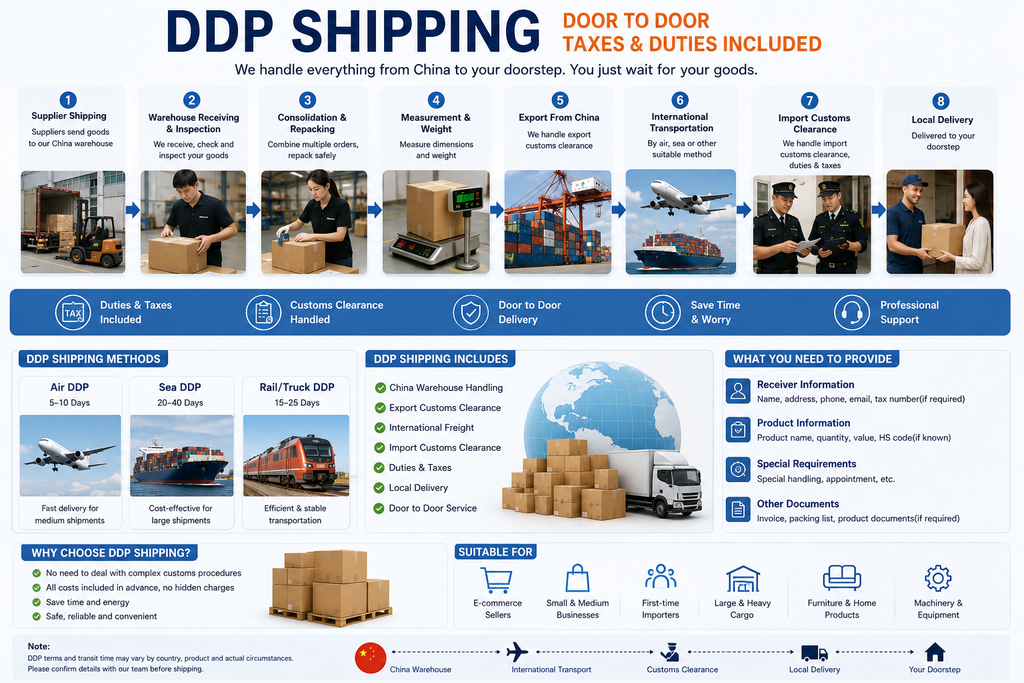
1. Confirm the Shipment Details
Before arranging DDP shipping, we first confirm the basic information about the shipment.
This normally includes:
- Product name
- Product category
- Menge
- Number of cartons
- Actual weight
- Carton dimensions
- Destination country
- Destination city
- Delivery address
- Receiver type
- Commercial or personal shipment
- Required delivery time
- Whether special handling is needed
Accurate information is important because DDP pricing and route availability depend on the actual cargo and destination.
2. Confirm Whether DDP Is Available for the Product
Not every product can use every DDP route.
Before quotation, we review whether the selected service can accept the goods.
Products may include:
- Allgemeine Güter
- Clothing
- Shoes
- Accessories
- Möbel
- Building materials
- Maschinen
- Electronics
- Batterien
- Energy storage products
- Cosmetics
- Food products
- Liquids
- Powders
- Chemikalien
- Branded goods
Special products may require dedicated transport channels, additional documentation or different customs arrangements.
3. Confirm the Destination Country
DDP service conditions vary by destination.
Before arranging shipping, we confirm:
- Destination country
- State or province
- City
- Postal code
- Delivery address
- Commercial or residential delivery
- Whether the area is remote
- Whether truck access is available
- Whether special delivery conditions apply
Remote areas, islands and difficult-access locations may require additional delivery arrangements.
4. Review Import Requirements
Before shipment leaves China, we review the basic import requirements for the destination and product type.
This may involve checking:
- Product description
- HS code information
- Declared value
- Country of origin
- Import restrictions
- Required documents
- Product-specific requirements
- Customs clearance conditions
- Import tax treatment
The exact requirements depend on the destination country and the goods being shipped.
5. Confirm the Scope of the DDP Service
The scope of a DDP quotation should be clearly confirmed before shipping.
Depending on the route, the agreed service may include:
- China warehouse handling
- Export transportation
- Export customs procedures
- International freight
- Destination customs clearance arrangements
- Import duty handling
- Import tax handling
- Destination logistics
- Last-mile delivery
- Door-to-door delivery
The exact included charges should always be based on the confirmed quotation.
6. Confirm What Is Not Included
Some costs or services may fall outside the standard quotation.
Depending on the shipment, possible additional charges can include:
- Remote-area surcharge
- Delivery appointment fees
- Storage caused by receiver delays
- Re-delivery
- Customs inspection charges
- Special permits
- Product testing
- Additional documentation
- Oversized cargo handling
- Tail-lift delivery
- Forklift services
- Residential delivery surcharge
- Address correction
- Extraordinary customs requirements
Any known exclusions should be clarified before dispatch.
7. Receive the Goods at Our China Warehouse
Goods from one or several suppliers can first be sent to our China warehouse.
When packages arrive, we can record:
- Supplier
- Domestic tracking number
- Number of cartons
- Product information
- Arrival date
- Visible package condition
This allows the goods to be prepared in China before entering the international DDP route.
8. Consolidate Multiple Supplier Orders
If you purchase from several Chinese suppliers, their goods can be combined before international shipping.
For example:
- Supplier A sends clothing
- Supplier B sends accessories
- Supplier C sends packaging
- Supplier D sends promotional materials
The goods can first arrive separately at our warehouse and then be consolidated into fewer international shipping units.
This can simplify handling and reduce unnecessary duplicate shipments.
9. Inspect the Goods Before Shipping
If required, the goods can be checked before DDP transportation begins.
Depending on the customer’s instructions, we can check:
- Menge
- Model
- Color
- Size
- Visible condition
- Packaging
- Labels
- Accessories
- Obvious damage
Photos or videos can also be provided before the goods are packed for international shipping.
10. Repack the Shipment
Supplier packaging is often designed for domestic delivery in China rather than international transportation.
When appropriate, we can:
- Remove unnecessary outer packaging
- Replace damaged cartons
- Use stronger cartons
- Add protective materials
- Reduce excessive empty space
- Separate fragile items
- Reinforce heavy cartons
- Prepare pallets or wooden cases
The objective is to prepare the goods for the longer international journey.
11. Measure the Final Shipment
After consolidation and repacking, the final shipment is measured.
We record:
- Length
- Width
- Height
- Number of cartons
- Pallet dimensions
- Wooden-case dimensions
The final dimensions are important because DDP freight prices may be calculated using volumetric weight.
12. Weigh the Final Shipment
The shipment is weighed after final packing.
We can record:
- Weight per carton
- Total actual weight
- Pallet weight
- Wooden-case weight
The final packed weight is used for the shipping quotation and transport arrangement.
13. Calculate Chargeable Weight
Depending on the selected DDP route, the freight may be calculated using actual weight or volumetric weight.
A large but lightweight shipment may therefore be charged at a higher volumetric weight.
The calculation depends on:
- Shipping method
- Carrier rules
- Route
- Carton dimensions
- Actual weight
Final pricing should be based on the completed shipment rather than early supplier estimates whenever possible.
14. Select the Appropriate DDP Route
Different DDP routes can be used depending on the goods and destination.
Possible solutions may include:
- Air DDP
- Sea DDP
- Rail DDP
- Truck DDP
- Express-style DDP channels
- Special cargo DDP routes
Availability depends on the destination, product type, shipment size and current transport conditions.
15. Air DDP Shipping
Air DDP can be suitable when delivery speed is important but traditional courier shipping is not the best option.
It may be used for:
- Commercial goods
- Medium-sized shipments
- Clothing
- Consumer products
- Electronics
- Time-sensitive orders
The shipment normally moves by air to the destination region before customs clearance and local delivery.
16. Sea DDP Shipping
Sea DDP is often suitable for heavier or larger shipments.
It may be used for:
- Möbel
- Building materials
- Maschinen
- Large commercial orders
- Pallets
- Wooden cases
- High-volume cargo
Sea transportation normally takes longer than air transportation but can be more suitable for heavy or bulky goods.
17. DDP for Batteries and Special Cargo
Some batteries and other special products may be shipped using dedicated DDP routes when appropriate channels are available.
Before acceptance, we may need to review:
- Battery type
- Battery chemistry
- Voltage
- Capacity
- Product model
- UN38.3 information
- SDS or MSDS
- Packaging
- Reiseziel
- Carrier requirements
Special cargo should not be assumed to follow the same process or price as ordinary goods.
18. Prepare the Packing List
A packing list may be required for the shipment.
It can include:
- Product description
- Menge
- Number of cartons
- Net weight
- Gross weight
- Carton dimensions
- Product model
- Packing information
The information should reasonably correspond to the actual shipment.
19. Prepare the Commercial Invoice
International customs procedures may require a commercial invoice.
Typical information includes:
- Seller or shipper information
- Buyer or receiver information
- Product description
- Menge
- Unit value
- Total value
- Currency
- Country of origin
- Other required commercial information
The declaration should reflect the actual transaction and applicable customs requirements.
20. Confirm Product Description
A clear product description is important for customs handling.
Descriptions should identify what the product actually is.
For example, instead of using a vague description such as:
“Accessories”
a more useful description may be:
“Stainless steel furniture handles”
The required level of detail depends on the product and destination.
21. Review HS Code Information
An HS code may be required for customs classification.
The classification can affect:
- Import duties
- Taxes
- Customs requirements
- Product restrictions
- Required documents
Where classification is uncertain, the importer, customs broker or relevant customs authority may need to confirm the correct code.
22. Confirm the Declared Value
The declared value is used for customs purposes and should reasonably reflect the commercial transaction.
The customer should provide accurate commercial information.
Incorrect declarations can create customs delays, additional charges or compliance problems.
23. Prepare Special Product Documents
Some goods require additional documents.
Depending on the product, these may include:
- Battery documentation
- UN38.3 test summary
- SDS or MSDS
- Product specification sheets
- Certificates
- Material information
- Ingredient information
- Import licenses
- Compliance documentation
Requirements vary by product and destination.
24. Confirm Receiver Information
Before dispatch, the receiver details should be checked carefully.
This may include:
- Full receiver name
- Company name
- Street address
- City
- State or province
- Postal code
- Country
- Telephone number
- Email address
- Tax information where required
- Importer information where required
Incorrect delivery details can delay customs clearance or final delivery.
25. Confirm Importer Requirements
DDP does not mean that every country allows the same import structure.
Depending on the destination and shipment, customs may require:
- A local importer
- Tax identification
- VAT or GST registration
- EORI number
- Business registration
- Import license
- Local customs documentation
The specific requirements must be confirmed for the actual shipment and destination.
26. Final DDP Quotation
Once the final packed information is available, the DDP quotation can be prepared.
Pricing may consider:
- Produkttyp
- Actual weight
- Volumetric weight
- Number of cartons
- Reiseziel
- Shipping method
- Import duty
- Import tax
- Customs clearance
- Local delivery
- Besondere Handhabung
- Remote-area delivery
The customer should confirm the quotation before the shipment enters the international transport network.
27. Confirm the Estimated Transit Time
The estimated delivery time depends on the route.
Transit time may be affected by:
- Air or sea schedule
- Consolidation schedule
- Export processing
- Destination customs clearance
- Customs inspection
- Peak season
- Public holidays
- Weather
- Port congestion
- Flight availability
- Last-mile delivery
Unless specifically guaranteed in writing, delivery times should normally be treated as estimates.
28. Final Pre-Shipment Check
Before dispatch, the warehouse can complete a final review.
This may include:
- Number of cartons
- Final weight
- Final dimensions
- Packaging condition
- Receiver information
- Shipping labels
- Required documentation
- Special handling instructions
This helps reduce avoidable problems after the shipment leaves China.
29. Take Final Shipment Photos
Final photos can be taken before handover to the international carrier.
The photos may show:
- All cartons
- Carton condition
- Pallets
- Wooden cases
- Shipping labels
- Reinforcement
- Final packing condition
This gives the customer a visual record of the shipment before international transportation begins.
30. Handover to the DDP Logistics Route
Once the shipment is confirmed, it is handed over to the selected DDP transport network.
Depending on the route, the shipment may first move to:
- Air cargo terminal
- Export warehouse
- Freight consolidation facility
- Seaport
- Container warehouse
- Truck terminal
The international transport process then begins.
31. Export Customs Procedures in China
The shipment may need to complete export procedures before leaving China.
This can include:
- Export documentation
- Shipment declaration
- Cargo information review
- Customs handling
- Carrier acceptance
The exact process varies by shipping method and cargo type.
32. International Transportation
The cargo then moves from China toward the destination country.
Depending on the selected DDP service, transportation may involve:
- Aircraft
- Ocean vessel
- Rail
- International truck
- Multiple transport modes
Some routes may include one or more transit hubs before reaching the destination.
33. Arrival at the Destination Country
When the shipment reaches the destination, it normally enters the local import and customs process.
It may arrive at:
- Airport cargo terminal
- Seaport
- Customs warehouse
- Bonded facility
- Regional logistics hub
The shipment must complete the required import procedures before final delivery.
34. Import Customs Clearance
Customs clearance may involve reviewing:
- Commercial invoice
- Packing list
- Product description
- HS code
- Declared value
- Country of origin
- Importer information
- Product documents
- Duty and tax information
Customs authorities may request additional information when necessary.
35. Customs Inspection
Some shipments may be selected for customs inspection.
This can include:
- Document inspection
- Package inspection
- Product inspection
- Value verification
- Classification review
- Additional information requests
Customs inspections are controlled by the relevant authorities and may extend the delivery time.
36. Import Duty Handling
Where import duty is included in the confirmed DDP arrangement, duty handling forms part of the agreed service scope.
The actual duty treatment depends on:
- Product classification
- Customs value
- Destination country
- Applicable tariff rules
- Trade agreements where applicable
The quotation should specify how duty is handled.
37. VAT, GST or Other Import Tax Handling
Some countries apply import VAT, GST or similar taxes.
Whether these charges are included depends on the confirmed DDP service and destination.
The shipment should not be assumed to include every possible tax or local charge unless it is clearly included in the quotation.
38. Release From Customs
After customs clearance is completed, the shipment is released into the domestic logistics network.
It may then move to:
- Regional warehouse
- Local distribution center
- Trucking company
- Courier network
- Last-mile delivery provider
39. Last-Mile Delivery
The final delivery stage transports the goods from the destination logistics facility to the receiver.
Depending on shipment size, this may be completed by:
- Parcel courier
- Local express company
- Freight truck
- Pallet carrier
- Commercial delivery service
40. Door-to-Door Delivery
For a door-to-door DDP service, the shipment is delivered to the confirmed destination address according to the agreed delivery conditions.
The receiver normally does not need to arrange the main international freight or standard customs process separately.
This is one of the main reasons overseas buyers choose DDP shipping.
41. Large Cargo Delivery
Large cargo may require additional delivery preparation.
For furniture, machinery, pallets or wooden cases, the receiver may need:
- Forklift
- Loading dock
- Warehouse staff
- Unloading space
- Delivery appointment
- Suitable truck access
DDP transportation does not automatically mean that unloading labor or lifting equipment is included.
42. Remote-Area Delivery
Some addresses are classified as remote or difficult to access by local carriers.
This may result in:
- Additional delivery fees
- Longer delivery times
- Alternative delivery arrangements
- Collection from a nearby terminal
The postal code should be checked before quotation whenever possible.
43. Tracking During Transportation
Tracking information may be available after the shipment enters the DDP route.
Depending on the service, tracking may include:
- International tracking number
- Air waybill
- Container information
- Logistics reference
- Local courier tracking number
The tracking format depends on the route.
44. Tracking Number Changes
Some DDP routes use several transport stages.
The shipment may therefore receive:
- One reference during transportation from China
- Another reference after customs clearance
- A final local courier tracking number
A tracking-number change does not necessarily mean the shipment has been replaced or lost.
45. Delivery Status Updates
Depending on the route, shipment updates may include:
- Departed China warehouse
- Export processing
- International transit
- Arrived at destination
- Customs clearance
- Customs released
- Local distribution
- Out for delivery
- Delivered
Not every DDP route provides the same level of real-time tracking.
46. Delivery Confirmation
After the shipment is delivered, the receiver should check the package condition.
If visible damage is found, it is useful to:
- Photograph the cartons
- Photograph damaged areas
- Keep the packaging
- Record the delivery condition
- Keep delivery documents
- Report the issue promptly
These records may be necessary if a transportation claim needs to be reviewed.
47. DDP Shipping From Multiple Chinese Suppliers
DDP shipping can be particularly useful when buying from several suppliers in China.
Instead of arranging international shipping separately with each supplier, the goods can first be sent to one China warehouse.
The process can include:
- Receiving supplier shipments
- Matching orders
- Prüfung
- Photos and videos
- Konsolidierung
- Neuverpackung
- Final weighing
- Final measurement
- DDP quotation
- International shipping
This gives the buyer one coordinated shipment instead of several unrelated international shipments.
48. DDP Shipping for Small Businesses
Small businesses often use DDP when they want a more predictable door-to-door shipping arrangement.
It can reduce the need to separately coordinate:
- China export transportation
- International freight
- Destination customs broker
- Import handling
- Local delivery
The exact responsibility still depends on the confirmed service terms and destination requirements.
49. DDP Shipping for First-Time Importers
DDP can be useful for buyers who have limited experience with international freight.
A coordinated service can simplify:
- Warehouse handling
- Shipment preparation
- International transportation
- Customs arrangements
- Final delivery
However, buyers should still understand what is included in the quotation and whether any local importer information is required.
50. DDP Shipping for Furniture and Building Materials
Furniture and building materials often require larger shipping units and stronger packaging.
A typical arrangement may involve:
- China warehouse receiving
- Product checking
- Packaging reinforcement
- Palletization
- Wooden cases
- Sea DDP
- Destination customs clearance
- Truck delivery
The final delivery address should be able to receive large cargo.
51. DDP Shipping for Commercial Orders
For commercial shipments, additional information may be required.
This can include:
- Company name
- Business address
- Tax number
- Importer details
- Commercial invoice
- Product description
- HS code
- Declared value
- Product-specific documents
The requirements depend on the destination country.
52. DDP Shipping for Samples
Samples from one or multiple suppliers can also be consolidated and shipped through suitable DDP or door-to-door routes where available.
This may be useful when a buyer receives:
- Factory samples
- Packaging samples
- Material samples
- Prototype products
- Several supplier samples
The goods can be checked together in China before international dispatch.
53. When DDP May Not Be the Best Option
DDP is convenient, but it is not automatically the best choice for every shipment.
Another shipping arrangement may be more suitable when:
- The buyer has their own customs broker
- The buyer wants to use their own import account
- The shipment is extremely large
- Special import permits are required
- The product is highly regulated
- A specific Incoterm is required by the commercial contract
- The buyer already has negotiated freight rates
The shipping method should be selected based on the actual order rather than using DDP for every shipment.
54. Why the Final DDP Price Can Change
An early shipping estimate may change after the goods arrive at the warehouse.
Common reasons include:
- Actual weight differs from supplier information
- Cartons are larger than expected
- Volumetric weight increases
- More cartons arrive than expected
- Product category is different
- Special documentation is required
- Destination changes
- Remote-area delivery applies
- Additional packaging is needed
A final quotation based on actual warehouse measurements is therefore more reliable than an early estimate.
55. Why Packaging Matters for DDP Shipping
International DDP shipments may pass through several handling points before reaching the receiver.
The goods may be:
- Loaded
- Unloaded
- Konsolidiert
- Transferred
- Customs inspected
- Sorted
- Transported by truck
- Delivered locally
Strong and appropriate packaging is therefore important even when the service is door to door.
56. Photo Confirmation Before DDP Dispatch
Customers can request final photos before dispatch.
The photos can confirm:
- Final carton quantity
- Packing condition
- Reinforcement
- Pallet condition
- Wooden cases
- Shipping labels
- Overall shipment condition
This gives the customer a final opportunity to review the shipment before transportation begins.
57. A Typical DDP Shipping Process
A complete DDP shipment can therefore involve:
- Supplier ships goods to our China warehouse
- Warehouse receives the goods
- Goods are identified and checked
- Photos or videos are provided
- Multiple orders are consolidated
- Goods are repacked when necessary
- Final weight and dimensions are recorded
- Required shipment documents are prepared
- DDP shipping quotation is confirmed
- Goods leave the China warehouse
- Export procedures are completed
- International transportation begins
- Goods arrive at the destination country
- Import customs clearance is arranged
- Duty and tax handling follows the confirmed service scope
- Goods are released from customs
- Local delivery is arranged
- Shipment reaches the final destination
The goal of DDP shipping is to provide overseas buyers with a more coordinated route from our China warehouse to the agreed delivery destination, with the exact responsibilities and included charges confirmed before the shipment leaves China.